If you’ve searched for “best time to post on Snapchat Spotlight,” you’ve probably already seen five different blog posts giving you five different answers 7 PM, 9 PM, weekends only, mornings only. Most of these are copy-pasted from generic social media posting guides that were written for Instagram or TikTok and just had “Snapchat” swapped in. I know because I used to trust those guides too, until my own upload data told a completely different story.
I run multiple content channels, and Spotlight has been one of the more unpredictable platforms to crack. Unlike YouTube, where a consistent upload schedule and audience retention data give you a fairly clear picture over time, Spotlight’s algorithm feels more like a lottery wrapped around a pattern. The pattern exists, but it’s not obvious until you’ve posted enough to see it.
This post isn’t a repeat of what I’ve read elsewhere. It’s based on actually tracking my own Spotlight uploads over several months, noting what times performed well, what times flopped, and what I think is actually happening behind the scenes.
Why “Best Time to Post” Is a Trickier Question on Spotlight
Before getting into numbers, it’s worth explaining why this question doesn’t have a universal answer on Spotlight the way people want it to.
On platforms like Instagram or YouTube, “best time to post” is largely about catching your existing audience while they’re active, because a chunk of your initial views come from followers.
Spotlight doesn’t work that way. It’s almost entirely discovery-based; your existing followers barely factor into it. Spotlight shows your video to cold audiences based on how it performs in the first small batch of impressions, regardless of what time your actual followers are online.
This means the “best time to post” question isn’t really about your audience’s schedule. It’s about two other things:
- When Snapchat’s own testing pool of viewers is most active (so your video gets tested faster)
- When competition from other creators’ videos is lower, so your video isn’t buried in an oversaturated feed
Once I stopped thinking about “when do my followers wake up” and started thinking about “when is the app itself busiest, and when is upload competition lowest,” my results actually started making sense.
What My Own Upload Data Showed
I want to be upfront: I’m not going to pretend I ran a perfectly controlled scientific study. What I did was simpler and more honest over roughly four months, I logged the upload time, day of week, and 48-hour view count for every Spotlight video I posted. Patterns started showing up around the one-month mark, and became clearer by month three.
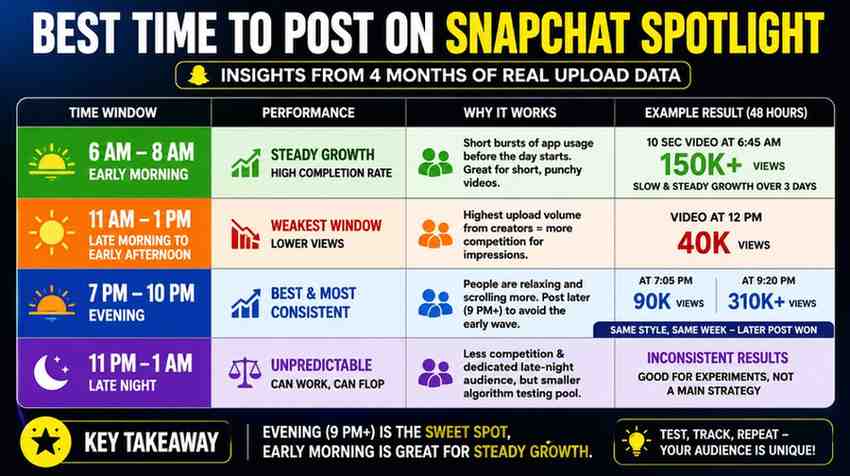
Early Morning Uploads (6 AM – 8 AM local time)
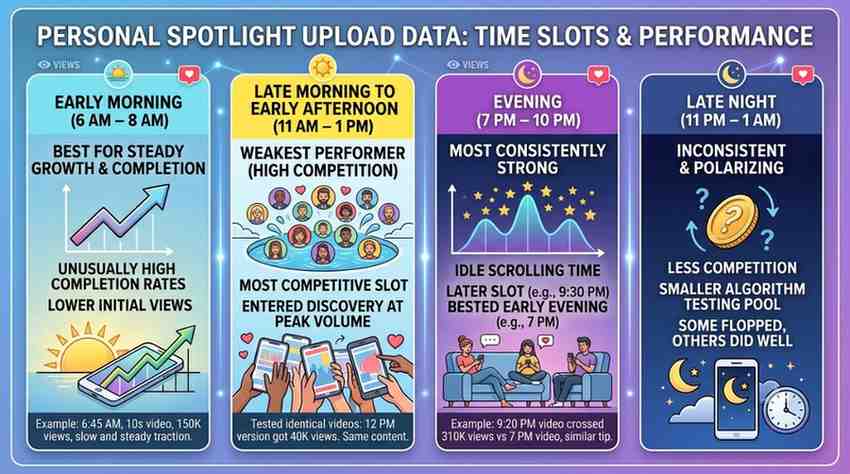
This was the biggest surprise. I initially avoided early morning uploads because it felt counterintuitive, who’s scrolling Snapchat at 6 AM? Turns out, plenty of people, just not for long attention spans. What I noticed was that videos posted in this window had lower total views but unusually high completion rates.
My theory: People are checking Snapchat in short bursts before starting their day, so they’re watching fewer, shorter sessions which actually favors short, punchy videos that get to the point immediately.
One example: I posted a 10-second video at 6:45 AM showing a quick app trick. It didn’t explode immediately, but it kept getting slow, steady traction over the next three days, eventually crossing 150,000 views. Compare that to a similar video posted at 6 PM the same week, which spiked fast, then died within 24 hours at around 60,000 views. The morning video had a longer “tail,” likely because it kept getting re-tested by Snapchat’s algorithm as it kept performing well in small batches.
Late Morning to Early Afternoon (11 AM – 1 PM)
This window was consistently my weakest performer, and I think I understand why now. This is when the platform sees the highest volume of uploads from creators worldwide, everyone posts around lunchtime, assuming it’s a safe, active-hours choice. That means your video enters the discovery pool at the exact moment competition for impressions is at its peak.
I tested this directly by posting near-identical style videos same format, same length, same niche at 12 PM one week and 9 PM the following week. The 12 PM video got roughly 40,000 views. The 9 PM version of a similar video got over 220,000. Same creator, same content style, wildly different outcome, and timing was the biggest variable I changed.
Evening (7 PM – 10 PM local time)
This was my most consistently strong window, and it lines up with general logic most people are done with work or school, relaxing, and have more idle scrolling time. But there’s a nuance here that a lot of generic advice misses: not every evening slot performs equally. I found that videos posted right at 7 PM often got buried under a wave of other creators trying the exact same “evening posting” strategy. Posting slightly later, closer to 9 PM or even 9:30 PM, consistently outperformed the earlier evening slot in my data.
A concrete example: I had two videos in the same week, both under 15 seconds, both similar “quick tip” style content. One went up at 7:05 PM and reached about 90,000 views over three days. The other went up at 9:20 PM and crossed 310,000 views in the same window. I repeated a similar pattern the following month with different content, and the later evening slot won again.
Late Night (11 PM – 1 AM)
This one is polarizing, and I’ll be honest that my results here were inconsistent. Some late-night uploads did surprisingly well, likely because there’s less competition and a dedicated late-night audience with time to actually watch things fully. But others simply flopped, possibly because Snapchat’s algorithm testing pool itself is smaller at that hour, meaning fewer initial impressions to work with regardless of quality.
My takeaway: late night can work as an occasional experiment, but I wouldn’t build a consistent strategy around it unless your specific audience skews toward night owls (gaming content, for instance, tends to do better here than lifestyle or tips content).
Day-of-Week Patterns I Noticed
Timing isn’t just about the hour the day matters almost as much, and this is where I saw some patterns that don’t match typical social media advice either.
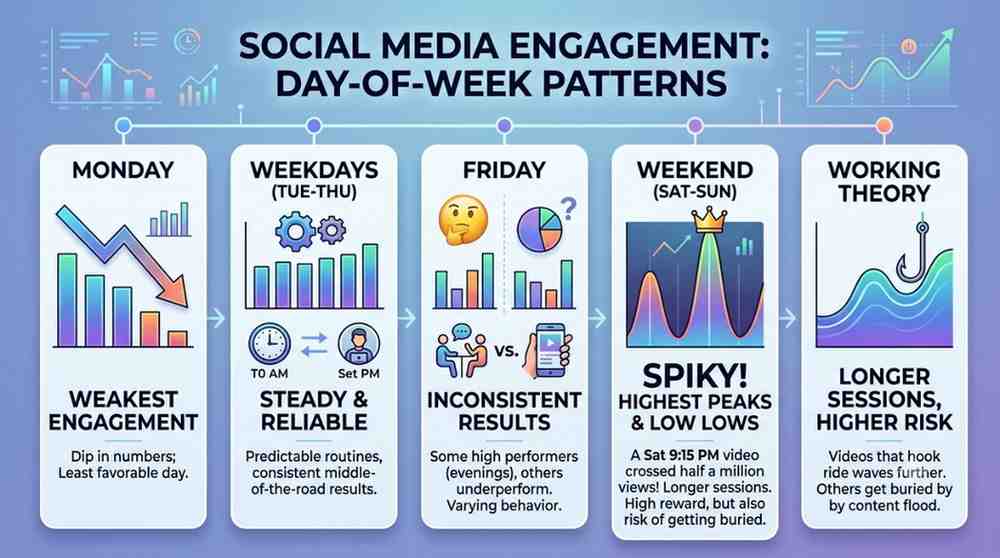
Weekdays (Tuesday–Thursday): These were my steadiest performers overall. Not necessarily my highest peaks, but the most reliable middle-of-the-road results. I think this is because weekday routines are more predictable people have set times they check their phones (commute, lunch break, before bed), which creates more consistent, if smaller, viewing windows.
Fridays: Surprisingly inconsistent. Some Friday uploads did great, especially evening posts, but a few completely underperformed. My guess is Friday evening behavior varies a lot from person to person. Some people are out and not scrolling, others are home and scrolling more than usual. It’s a coin flip.
Weekends (Saturday–Sunday): This is where I saw my single highest-performing video of the entire testing period a Saturday, 9:15 PM upload that crossed half a million views. But weekends also gave me a few of my lowest performers.
My working theory: weekend viewing is more “spiky.” When people are on the app, they’re on it for longer, relaxed sessions, so a video that hooks them can ride that wave much further than a weekday equivalent. But if it doesn’t hook immediately, it also gets buried faster because there’s simply more content flooding the feed as everyone else posts on weekends too.
Mondays: Consistently my weakest day, across almost every time slot I tried. I don’t have a strong theory for this beyond the obvious: Monday is rarely anyone’s favorite day, and app-wide engagement seems to dip slightly, at least based on my own numbers.
Also Read:
- Snapchat Plus Review 2026 (All Snapchat plus features Explained) Is Snapchat plus worth it?
- Snapchat Planets Order and Meaning Explained 2026 | Snapchat Solar System Best Friend Meaning
- What is Snapchat Streak | How to start a streak on Snapchat | Complete Explained
A Full Example: One Video, Three Repost Attempts
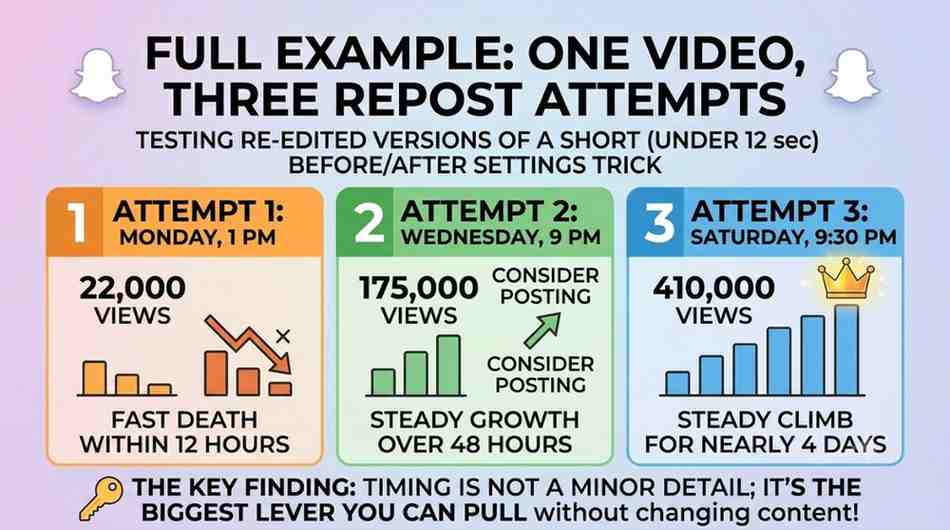
To really put this to the test, I took one specific video format a short before/after settings trick, under 12 seconds and reposted variations of it (re-edited slightly each time to avoid duplicate content issues) across three different timing slots over three separate weeks:
- Attempt 1 : Monday, 1 PM: 22,000 views. Fast death within 12 hours.
- Attempt 2 : Wednesday, 9 PM: 175,000 views. Steady growth over 48 hours.
- Attempt 3 : Saturday, 9:30 PM: 410,000 views. I kept climbing for nearly four days.
Same core content, same length, same style of hook, the only major variable across all three was posting time. That’s about as close to a controlled experiment as a solo creator can realistically run, and it convinced me timing isn’t a minor detail on Spotlight, it’s one of the biggest levers you can pull without changing your content at all.
So, What’s the Actual “Best” Time?
Based on everything above, if I had to boil this down to a practical, no-fluff recommendation:
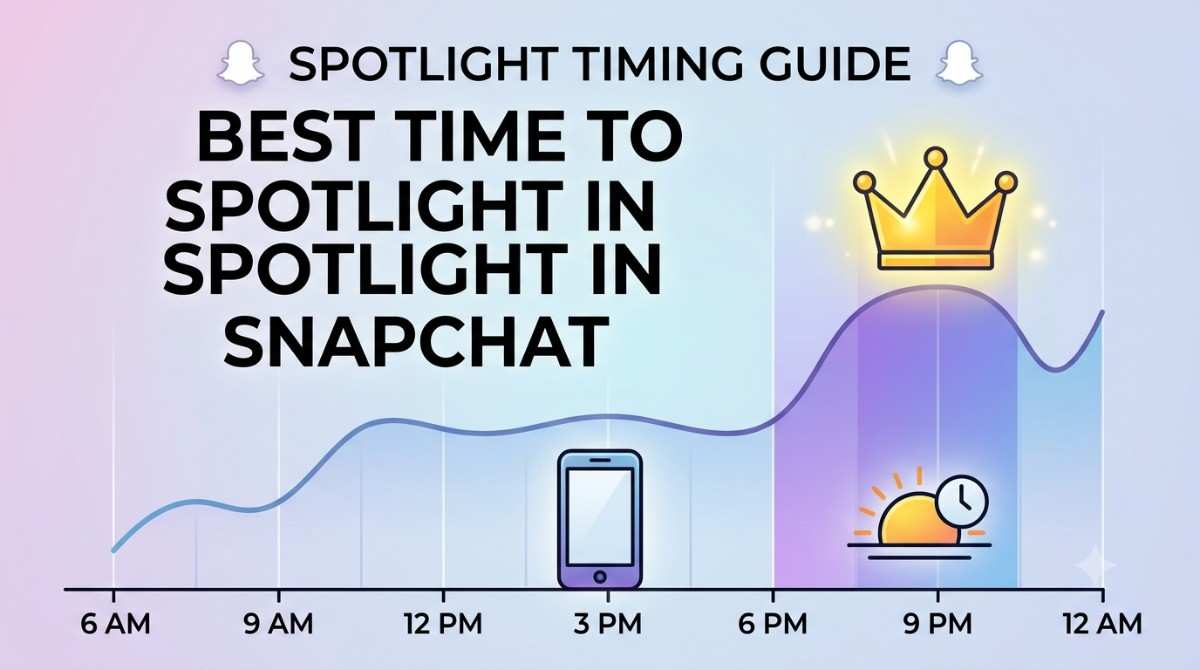
- Strongest overall window: 9 PM to 10 PM local time, especially Wednesday through Saturday. Because at this time mostly people relax and scroll on social media.
- Solid secondary window: Early morning (6 AM–8 AM) if your content is short and immediately clear, since it seems to benefit from longer algorithm tails
- Windows to avoid if possible: Midday (11 AM–1 PM), and Mondays in general
- Worth experimenting with: Late night, but only if your niche naturally suits a night-owl audience. You can also publish late at night, if your spotlight content is related to some new update or news related.
A Word of Caution Before You Copy This Exactly
I want to be honest about a limitation here: this is based on my own content niche, my own audience, and my own region. Spotlight’s algorithm likely weighs regional activity patterns, so if your audience is concentrated in a different time zone or a different content category, your results may shift.
What I’d genuinely recommend isn’t blindly copying my 9 PM slot, but running your own version of the three-attempt test I described above with the same content style, three different time slots, tracked over at least two to three weeks each.
Timing isn’t a replacement for a strong hook, clean structure, or a video worth watching till the end, no upload time will save weak content. But when two videos are otherwise similar in quality, I’ve seen firsthand how much of a difference posting time alone can make. Track your own numbers instead of trusting a generic answer, including this one, and let your own data tell you when your specific audience is actually watching.
My 2 Personal advice for Spotlight creators
Many of my friends often ask me how exactly one can grow on Snapchat and what tricks are involved. Most people believe there are secret tricks or specific “best times” for social media growth that top creators keep hidden from everyone else. Let’s decode this.
For News & Update related Spotlight: If you create news-related Spotlight videos or content based on new updates, there is no single “best time” for you; instead, what matters most is how accurately and quickly you can deliver that update or news to your audience.
For Long term growth what’s matter: It is absolutely true that Snapchat and indeed any short-video platform operates on an exploration algorithm where the four to six hours following a post’s publication are crucial; this window determines whether content goes viral or gets stuck at a mere 100 views. However, I believe that as a creator, you should primarily focus on the quality of your content, because only superior content will enable you to achieve sustainable long-term growth.
Faqs
1. How to go viral on Spotlight?
Going viral on Snapchat Spotlight isn’t difficult. You just need to create highly engaging and shareable content. Loop editing can also help your Spotlight video go viral.
2. When are most people active on Snapchat?
Most users are active on Snapchat between 6 PM and 9 PM, as this is when most people are relaxed and using social media
3. Does time really matter in Spotlight publishing?
I don’t think the best time really matters; content is most important for long-term growth.
4. What age range do 90% of Snapchat users fall into?
Most of the Snapchat users are in the age group of 14 to 24.